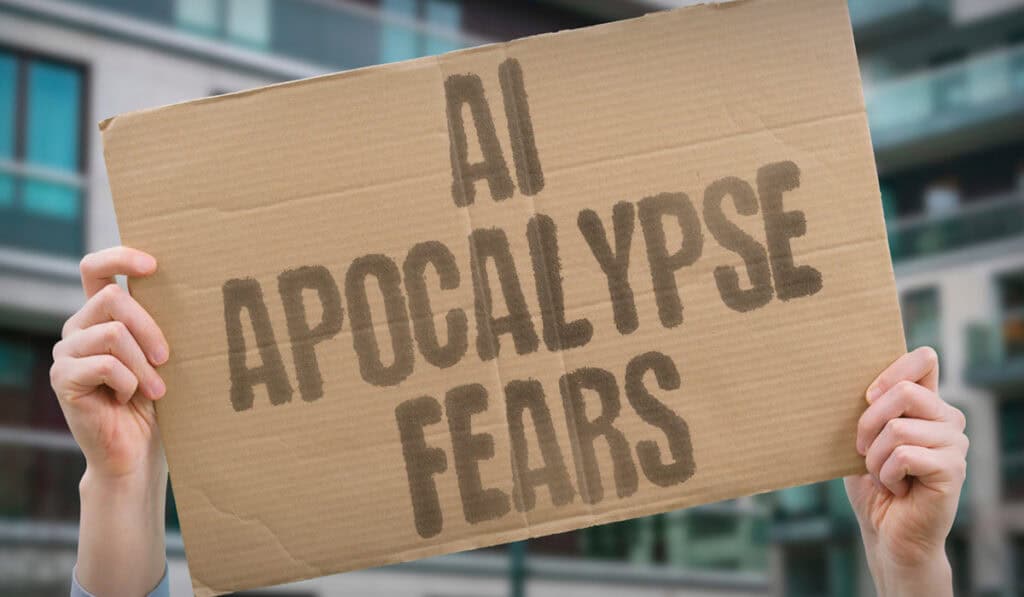
An Education Week article asks: Will exploding fears of AI’s potential risks fuel the growing pushback against the overuse of technology in schools?
Potential threats:
- AI can already be used to impersonate a principal’s voice or help a hacker breach schools’ cybersecurity safeguards.
- If AI bots could unwittingly, or on a human order, release a deadly virus, launch a nuclear weapon, or wreak havoc on vital infrastructure, as some tech experts warn, should a teacher think twice before using a chatbot to craft parent emails?
- Ongoing threats involve student data privacy, cognitive offloading and kids creating deepfakes.
“Educators and families have plenty to talk about, plenty to be concerned about, just addressing the harms that are caused today by these systems,” says Justin Reich, the executive director of MIT’s Teaching Systems Lab. “You don’t have to speculate about future harms.”
Dario Amodei, Anthropic’s CEO, called for a slowdown in AI development because the technology is developing too quickly for engineers to ensure that the requisite safety measures are in place.
“Over the last few months, I have become convinced that fully addressing the risks requires even more prudence—not just investing in risk prevention but pacing the rate of capabilities advancement so that risk prevention has time to keep up,” Amodei said.
Reich and others are skeptical of tech companies’ motivations in detailing AI’s potential downsides.
“These people are not honest,” Reich. “They’re self-motivated, and they’re really bad at predicting the future.”
The avalanche of dire warnings may trigger more school districts to consider banning or pausing adoption of AI tools for teaching and learning and managing schools, experts predict.
“These stories are truly scary, and when we’re scared, we want to push pause, and we want to protect our children,” says Jeremy Roschelle, the co-executive director of learning science research for Digital Promise, a nonprofit organization that works on equity and technology issues in schools. “I think it will increase the momentum to ban or pause” the use of student-facing generative AI tools in schools.
Recent developments:
- Florida’s state board of education has called for districts to allow families to decide whether to “opt-in” to letting their children use generative AI learning tools.
- New York City Public Schools and Los Angeles Unified School District recently hit the pause button on student use of AI tools. The Los Angeles policy restricts use of the technology for all students for this school year. New York prohibits AI in elementary and middle school but allows limited use in high schools this year.
Pressure to move carefully and deliberately in AI adoption might give districts time to decide when and how the tech can be most helpful, says Rebecca Winthrop, a senior fellow and director at the Center for Universal Education at the Brookings Institution.
A pause in the AI hype “will make it easier to actually slow down and try to do what I would call very good, useful, narrow AI use,” Winthrop says.
“Narrow” use of AI might include tools that help teachers analyze student data in real time to learn where students are struggling. Or it could use predictive AI to give students personalized reading and math practice problems, she says.
Winthrop recommends school districts steer clear of agentic AI. Agentic AI is designed to be proactive and perform multi-step tasks, such as booking travel or coding and fixing software programs.
“They should be very careful of having any agentic AI in their schools because it is not tested,” Winthrop says.
Mounting AI anxiety could prompt districts to scrutinize ed-tech tools that incorporate the technology instead of buying hundreds of tech tools with little vetting, Roschelle says.
“You don’t want a thousand new products entering schools that have been vibe coded and you actually don’t know what’s in them and what they do because they’ve been built very fast with not enough human supervision,” Roschelle says.
“As educators, we need to be careful that we’re vetting the tools that we’re bringing in,” says Matthew Callison, the director of innovation and strategic partnerships for the South Fayette Township public schools near Pittsburgh. “There are concerns that we need to take into account. There are guardrails we need to have in place.
“Our job is to help prepare students to be successful beyond our four walls, and that involves having conversations with caring adults and helping [students] understand and navigate these tools and these issues,” he says.
Heidi Sipe, the superintendent of the Umatilla School District in Oregon, has asked her student advisory board to help her think through the district’s approach to the technology. Students advocated for keeping AI out of writing classes, other than allowing it for initial brainstorming.
Some students shared positive experiences with virtual chatbot tutors, Sipe says. And they’ve suggested steps, such as training parents how to use AI, so they can help safeguard their children’s use of the technology.
Last summer, Umatilla students joined a group of 98 high schoolers from around the country to craft a national AI framework. Students from the district have also spoken about the technology’s implications for K-12 with state lawmakers.
“We have to be very cautious and think through what our core work [as educators] should be, and that is to develop strong learners who are skilled in critical thinking,” Sipe says.
“As we’re talking with students about all [this information], they should be reading, and they should be learning and they should be questioning. They should be asking: ‘What role should AI play in my life?” There are things beyond all of our control right now and that’s concerning.”
Education Week