Young children build stronger math understanding when math connects to their everyday lives, writes Ashley Landry, a first grade teacher at Reynolds Elementary in Spring ISD, Texas, in an eSchool News essay.
I spent years teaching in a system that made math feel like something you either got or you didn’t. Not everyone can be a “math person” … right?
What I’ve learned is that in math, a student’s final answer can only tell you so much.
In first grade, educators shape the trajectories of how students feel about math. Six- and seven-year-olds form beliefs about whether they are “math people,” if their ideas are worth sharing, and what their mistakes say about them as learners. These beliefs are hard to undo later, which means what happens in first grade matters more than we sometimes acknowledge.
For most of my career, I taught a lesson, students solved problems, I checked answers. With a very structured math curriculum and limited time for instruction, I, like most early education teachers, often have an incomplete picture of where every student’s understanding is.
Written (or digital) work can only tell you part of the story. First graders are still building writing stamina, fine motor skills, vocabulary, and confidence. Some know exactly what they mean but cannot yet get it onto paper. Others can complete a math worksheet with 100 percent accuracy but cannot explain why an answer makes sense. If I only look at students’ final answer, I miss all of that.
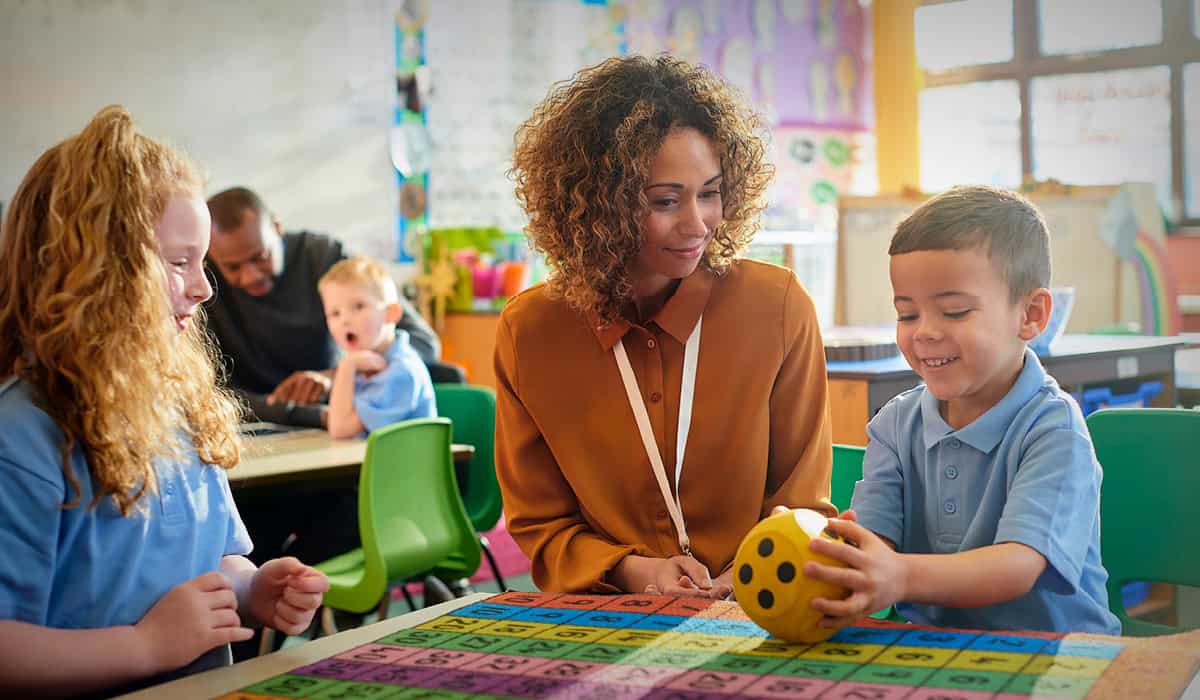
Research from NCTM shows that young children build stronger math understanding when it connects to their everyday lives. We’ve incorporated more play-based activities tied to things my students know well, like measuring ingredients for a recipe and tallying prices in a pretend toy store. Once math felt like part of the world they already knew, rather than something abstract and separate, learning it actually became fun.
As educators, we often hear what gets measured is what gets taught. In math, especially with limited instructional time and resources, it can be more efficient to skip right to the answer-getting. For young learners, there is so much value in the in-between. So I made an intentional shift in my math lessons to regularly ask students to explain their thinking out loud as they worked through problems.
When I listen to student explanations, I hear things I would never have caught on paper. I heard a student who knew the value of each coin but lost track while skip-counting. I heard several students who were confusing dimes and nickels, not because they didn’t understand value, but because the coins look so similar. I heard another child explain a strategy for adding the total value that was different from the one I had just taught.
Sometimes I watch their videos two or three times because they surprise me. You can literally see something shift as they explain math out loud in their own words to an imagined audience. They start using vocabulary more intentionally, demonstrate confidence as they share with each other, and understand that talking about math is just as important as “doing” math.
Making student explanation a regular part of our math practice required intentionality. It needed to be taught, modeled, and made safe. I could not have achieved the shift I saw with a one-off tool or strategy; I had to evolve my practice and get comfortable testing to find what worked. Some students required sentence starters while others needed more time with manipulatives before they were ready to share. Ultimately, students felt safe sharing and making mistakes without feeling like those mistakes defined them.
The technology I use captured and analyzed student explanations, which allowed me to “hear” every student in a way that I simply cannot do in real time. With a class of around 20, there’s not enough time in the day, let alone a single lesson, to pull up a chair next to each student and catch misconceptions the moment they happen. After revisiting explanations, I was able to respond faster and identify common patterns and misconceptions across the class.
As AI continues to evolve and make its way into more classrooms, we need supports that help us see our students more clearly so we can use our judgment more effectively. One thing I hope others can learn from my experience is that young children are capable of far deeper mathematical reasoning than we sometimes give them credit for. They will show us if we give them the right conditions to share it.
When a child who began the year hesitant to participate starts asking for more math, that means everything. She was always capable, but she needed the chance to see, hear, and believe it for herself.
eSchool News