Defining what makes a student good a “soft” or “durable” skills has never been easy, according to an article in The 74.
But now several companies and non-profits are deconstructing these skills to be able to teach and test them. Teachers, developers of tests, business leaders and other experts collaborate to break down these skills into smaller skills and then into even smaller subskills and nuances that can serve as steps toward mastery. Communications could include negotiating and public speaking as subskills, for example.
The outlines of skills and subskills are like a tree branching out into smaller and smaller limbs, all with the goal of making them as teachable and testable as math or English.
“There’s no system of capturing (these skills) and measuring them, because, frankly, we haven’t valued them as at the same level that we have academic skills,” says Laura Slover, managing director of Skills for the Future, a leader in trying to define and test soft skills.
“We’re trying to make what is invisible visible,” she says. “How do we flip the discussion about college applications and getting jobs, from how someone looks on paper to showing evidence of what they’re capable of?”
How to measure these long-undefined skills comes at a time as researchers, including from Harvard, the International Organisation for Economic Co-operation and Development (OECD) and, most recently, the XQ Institute, a nonprofit that promotes soft skills, have increasingly highlighted their importance in the changing economy.
XQ has listed developing measurements of soft skills as one of its 10 keys to adapting high school education for the future.
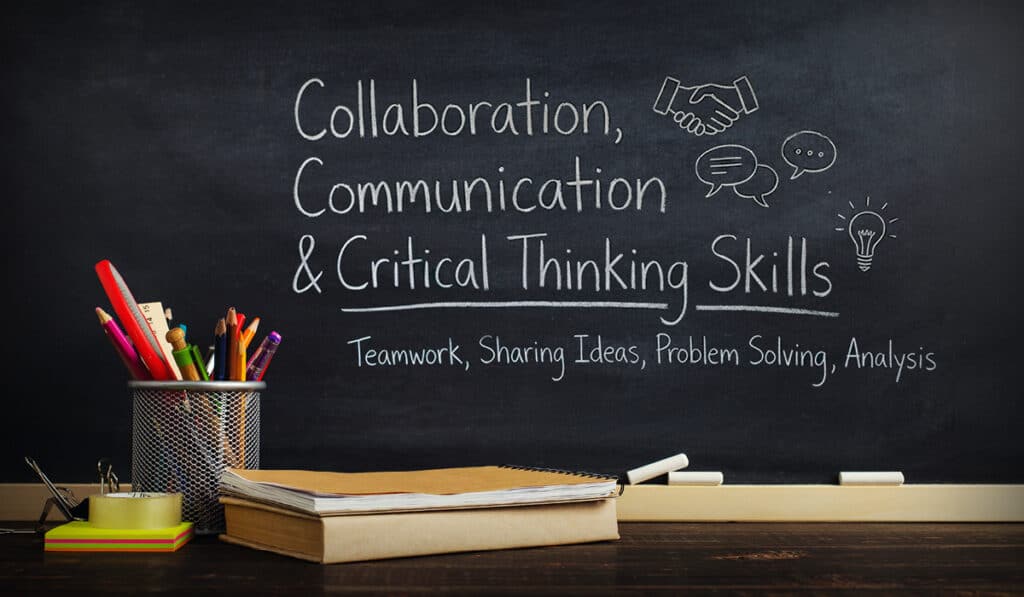
Skills For The Future released its breakdown of its first three skills — collaboration, communication and critical thinking — earlier this year, so lesson plans and tests of soft skills are still being developed. Making Waves was able last school year to use skills outlines from another partnership of a few companies known as Pathsmith to plan lessons on communication and of how students can take criticism constructively.
Tim Taylor, president of America Succeeds, a nonprofit that’s one of the major partners in Pathsmith, hopes the breakdowns of 10 skills the organization released in 2024 will help other companies develop ways to teach these skills as well as test them so employers can have some certainty a student has mastered them. Those skills include leadership, fortitude, character and mindfulness, as well as the three that Skills For The Future has tackled.
“When everybody has the same AI, then the things that really differentiate you are these durable skills,” Taylor says. “It’s your critical thinking, collaboration, growth mindset.”
Recent developments:
- An online assessment known as the California Critical Thinking Test has tried to gauge student skills of analysis, inference, evaluation, induction, and deduction for several years. It has been used by some universities to verify whether students were learning well.
- Skills For the Future, a partnership between six states, the Carnegie Foundation for the Advancement of Teaching and the Educational Testing Service, the company best known for running the SAT and GRE exams, already has prototypes of tests for high school students on collaboration, communication and critical thinking undergoing trials in a few schools in partnering states.
At the core of these tests are the detailed “skills progressions” outlining the three skills by breaking them down into three or four major subskills, then multiple “indicators” within each subskill.
It also shows how a student can progress in stages, using “exploring” a skill at the start, to “analyzing; “integrating” it into their work and then “extending” use of it. No A-F grades.
Communication is broken down into four subskills:
- Different communication modes, such as written vs verbal
- Adapting communication styles to different audiences
- Listening to others for deeper meaning
- Understanding and adapting to different emotional or ethical dynamics of an interaction
Critical thinking also has four major components: How students seek information, analyze it, form arguments and then reason with logic.
The breakdowns then go deeper. About half the evaluation of communication focuses on how well a student conveys a message. Beginners should recognize that communication should differ for different goals. At higher levels, a student should know how to tailor communication to the goal, as well as consider the needs of different audiences and respond to cues from an audience about how well the message is received.
The other half of the communication subskills focus on how well a student is hearing and understanding communication from others. That might include pausing before responding to be sure others have expressed themselves fully, adapting to cultural differences of others, asking questions to clarify what someone said or picking up on messages that may be implied but not clearly stated.
Similarly, critical thinking covers component skills such as fact-checking, using multiple sources of information, using evidence over opinion in reaching conclusions, using deductive reasoning and recognizing and avoiding logical fallacies,
ETS researcher Teresa Ober Ober says because the skills progressions are designed for tests and to guide teachers in rating students, many indicators are behaviors a teacher can observe a student doing or not doing.
“The indicators are still pretty general, but they allow us to get that much closer to observable behaviors,” Ober says. “Because we are a measurement organization, we are really focused on things that we can observe — that provide evidence of a particular construct, a particular competency.”
Skills for the Future hopes to have new assessments of collaboration, communication and critical thinking that include exams — and ways to allow students to demonstrate mastery with projects or presentations available to schools.
Pathsmith developed outlines of 10 skills by searching 80 million job advertisements for traits companies seek the most. The CompTIA digital training and certification company also joined the partnership.
“We define durable skills as how you use what you know, then how you show up in the world,” Taylor says. “The goal is to be able to signal to employees what you know, what you can do related to these skills, at what level.”
Pathsmith uses subskills — between four and eight for each of the 10 main skills— and spells out how skills develop over time through four performance levels — emerging, developing, applying, succeeding.
It divides communication into eight subskills or contexts requiring different approaches. These include written vs. verbal, negotiations, customer service, on social media and public speaking.
Tests of the skills are not in the pipeline yet, though Pathsmith hopes vendors will step forward to develop some, so that students can prove to employers they have a skill in a way employers will trust.
“We don’t want to say who can build it and who can’t,” Taylor says. “We just want to make sure that the market has an opportunity to start with a really quality back end, and they don’t have to start from scratch.”
Whether universities and companies buy into the tests and treat the ratings as real credentials for college admissions and hiring will be key to whether either Pathsmith or Skills To The Future frameworks succeed.
The 74