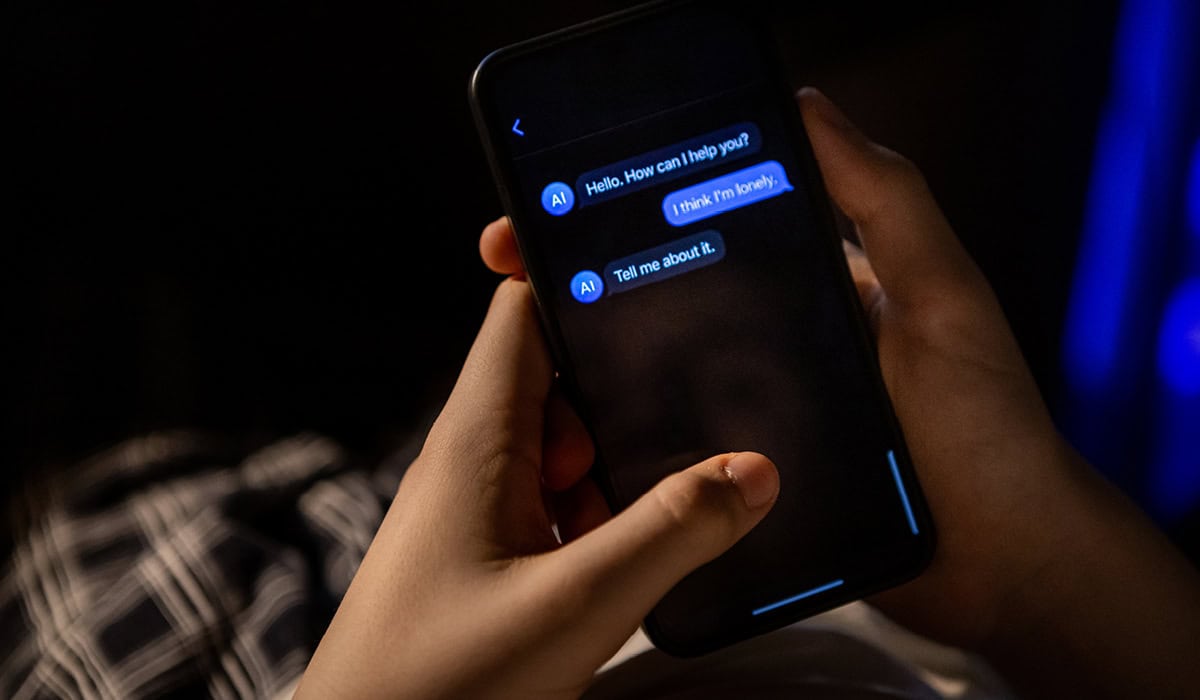
A new survey offers a detailed look at how young people are developing emotional relationships with AI, according to an article in The 74.
This new survey by The Rithm Project, a nonprofit focused on human connection in the age of AI, follows up on a large survey the group published in March of 2,383 young people ages 13 to 24. The March survey found that 18% use AI for personal and emotional support and 15% talk to AI characters and personas.
Researchers went back to subjects in those two groups for in-depth interviews, analyzing 29 conversations with participants ages 16 to 24. A few patterns emerged. None of the subjects said they set out to confide in a chatbot — rather starting by relying on AI for homework help, grammar checks, translating an MRI report or goofing around with an anime character.
What changed things in almost every case was a “gateway moment,” typically a rupture in a human relationship, according to researchers. “For a young person who’s viscerally feeling rejection, they need a place for that to land. And whereas four years ago there was no place for that to land besides sitting in it, they now have a place,” says Alison Lee, chief research and development officer for The Rithm Project.
Large language models are “omnibots,” apps that can basically do it all: help with homework, advise on what to wear to a dance class and weigh in on whether ramen is a sensible dinner choice, says Lee. Each use gives the model more context, making answers feel more personal, inviting still more disclosure. When a crisis hits AI is first choice advisor, she says.
AI paired with social media can be a powerful combination, according to the report. One subject, a 16-year-old, told researchers she started using Microsoft Copilot for schoolwork, then saw a TikTok creator say ChatGPT had changed her life during a mental health struggle. The student then built two AI personalities: a lighthearted “fun and funny” one for non-serious endeavors and a serious one she’d use as a therapist. “If something really serious happened,” she says, “I would pick up ChatGPT right away.”
Young people aren’t naive about chatbots — many can recite their flaws, including sycophancy, hallucinations and a tendency to tell users whatever they want to hear, according to the surveys.
They still use AI because AI doesn’t have to be trustworthy, it just has to be less risky than a real person, according to the report.
If survey subjects didn’t like what AI produced, they could try a different prompt or simply switch platforms. One young woman observed that to get a different response from her favorite chatbot, “You can literally just delete the chat history and then there’s just way less judgment.”
Young people see the problems inherent in AI, Lee says, but they find them manageable. The risks of talking to people felt “much more visceral.”
“Teens don’t have to trust AI to use it, they only have to trust it more than an alternative at that moment,” says Michael Robb, head of research at Common Sense Media. “It’s probably best to think about this less as a question about AI, and more of a question about adolescence.”
Teens are sensitive to the comparison culture. Telling a friend something embarrassing carries real stakes because “they will still see those friends at school the next day,” says Robb. AI carries no such threat, “and that’s very appealing to teens.”
Still, how much control do young people really have using AI? “It’s fine to say that you can move to a different platform or prompt AI in certain ways, but a lot of the ways that AI interacts with all of us are baked into the product and hard to avoid,” Robb says. “A teen may not be able to compare a risk they can see, such as having a friend judge them, with a risk they can’t, like AI.”
Whether AI draws young people closer to the people in their lives or pushes them away depends largely on what they asked it for help with, the subjects told researchers. Those who asked AI to help them see another person’s point of view, or how to improve their relationships after a fight, often returned with more confidence. One young man uploaded screenshots of an argument to understand what his girlfriend was saying beneath her anger.
Gabriel, 24, a former graduate student, said he was venting to ChatGPT about a frustrating relationship with his thesis adviser when he noticed it kept reassuring him that none of it was his fault. So he tested it with a scenario in which he was obviously in the wrong.
It sided with him anyway.
He then built a custom AI “philosopher” with instructions to push back on his ideas and spot flaws in his writing. Other interviewees took similar steps, not using AI when they were lonely or requiring themselves to try solving a problem on their own first.
Dana, 19, said she stopped using a Character.AI persona for emotional support after learning of a case in which a chatbot was linked to a user’s suicide.
But few subjects — about one in four — said they had little or no awareness of AI’s problematic behaviors. “I don’t think AI’s ever been off or wrong,” one said.
Young people receive little guidance on AI use, according to The Rithm Project survey. “What they’re hearing from adults is either ‘Just don’t use it, dummy,’ or ‘Go all in and learn all the things,’” says Lee. “There’s no third way meaningfully for them to be like, ‘O.K., I’m going to be more intentional and thoughtful, and these are the strategies that are available to me to actually tune it.’”
The 74