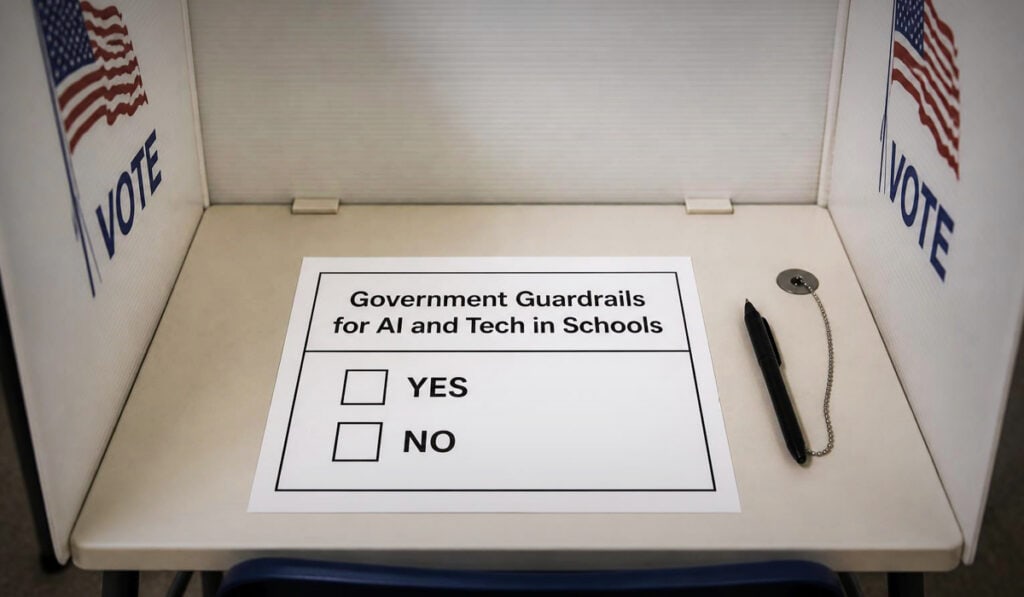
Americans overwhelmingly favor government regulation to ensure safe, effective use of artificial intelligence and other new technology in K-12 schools, according to survey data from The Century Foundation and reported in K-12 Dive.
At least 80% of those surveyed are “very” or “somewhat” concerned about six issues related to AI and technology, including:
- Students using AI to complete assignments without learning the material (85%);
- Teachers being pressured to use AI tools without proven pedagogic benefits (81%);
- Schools not doing enough to prepare students for a world rapidly changing due to AI (80%).
The survey of more than 2,000 voters found 86% of respondents are “very” or “somewhat” concerned about the impact of social media; 84% about private companies collecting and profiting from student data; and 81% about students using cell phones in class.
“We’re seeing these cell phone bans and other concerns about technology popping up across the country,” says Julie Margetta Morgan, president of The Century Foundation and a co-author of the report. “We’ve also had parents writing into the school districts, asking them to implement tougher restrictions.”
Superintendents and principals need to know these sentiments because state governments for the most part haven’t stepped in to “set rules of the road,” Morgan says.
When voters were asked whether they want teachers to handle school tech use issues on their own or if the government should set clear guardrails, 77% chose the latter. Almost half (49%) of respondents said in-class technology and AI use should be “kept to a minimum,” the report said.
“If the only people you’re hearing from on this are the companies that are marketing their products quite heavily to school districts, you might think you need to adopt a much more unreserved approach to technology in the classroom than what parents and other Americans are actually asking for,” Morgan says.
Districts and schools need to engage with parents on these questions and try to understand where they’re coming from, she says.
“We need to see schools raising this to lawmakers, that families are asking for someone to step in and set some basic ground rules. That doesn’t just mean ground rules within the schools,” Morgan says. “But also ground rules for the companies themselves.”
Now, superintendents must negotiate agreements with the companies, “which can be pretty onerous,” she says.
“They have unclear terms, and unclear tradeoffs in terms of what the school gets, versus what they’re giving up in terms of student data,” Morgan says. “We can also be asking legislators at both the federal and state level to step in here and level the playing field between the companies and the school districts.”
K-12 Dive