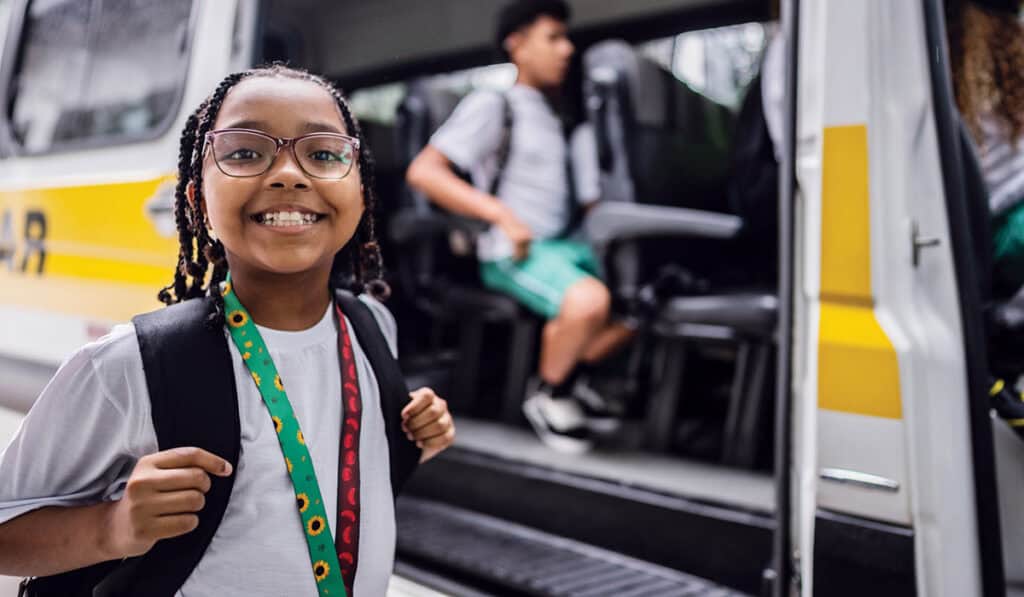
For many students, their ride to school is the first structured interaction of the day, and it sets the tone for everything that follows, writes Gladys De Lucio, director of transportation for East Aurora School District 131 in Illinois, in an essay in The 74.
Every school district I have worked in for 22 years asks the same question when a student’s attendance starts to slip: What is going on at home?
But before we look at home, I have learned to look at the ride.
Recent national research on transportation consistency backs up what I see in my district every morning. Sixty-nine percent of caregivers say a reliable ride leaves their child noticeably calmer. Students who arrive after a smooth transportation morning are far more likely to be calm and ready to learn than students who arrive after a difficult one.
Inconsistent transportation can have a huge impact on academic and social-emotional well-being for these students every day.
In our Illinois district, we schedule alternative transportation — typically vans and cars sent out on regular routes — to arrive at least 20 minutes ahead of the bell, because we do not know whether a student had breakfast at home. Maybe they did not have time, or the food was not available for them. That 20-minute cushion is one less barrier for a student who already has enough to manage, and it means they get a warm meal and a few minutes to settle before class starts.
The other piece is the driver. Students on alternative transportation do not always have consistency anywhere else in their day. We cannot always know what happens before they get into the vehicle or after it drops them off. What we can control is whether the same driver shows up at the same time in the same vehicle. That predictability becomes something a student and a family can count on. What’s more, consistency gives the driver a chance to notice when something is off and pass it along before it becomes a bigger problem.
I want to push back on one instinct I see in districts who are watching every dollar, which is pretty much everyone these days. When a neighboring district asked me what our alternative transportation partnership costs, my honest answer was that it is not the cheapest option available. It is also not the same value as the cheapest option available.
A day-and-night taxi will get a student from one address to another, but that is a ride, not a service. A service means cameras and GPS tracking on every vehicle, background-checked drivers, and a partner who tells you within 24 hours whether they can meet a student’s needs and holds to it. These are still our students. I would not put anything less in a vehicle with my own children, and I am not willing to put anything less in a vehicle with someone else’s.
None of this is complicated, and none of it requires a bigger budget than most districts already have. It requires treating the ride to school as part of the school day rather than a separate problem to be solved. When we do that, attendance — and the attendance-based funding many districts rely on — follows. So does trust, from families who have too often been told to wait five days for a solution that should take one conversation. Consistency is the structural piece that makes every other investment in a student’s education stick.
The 74