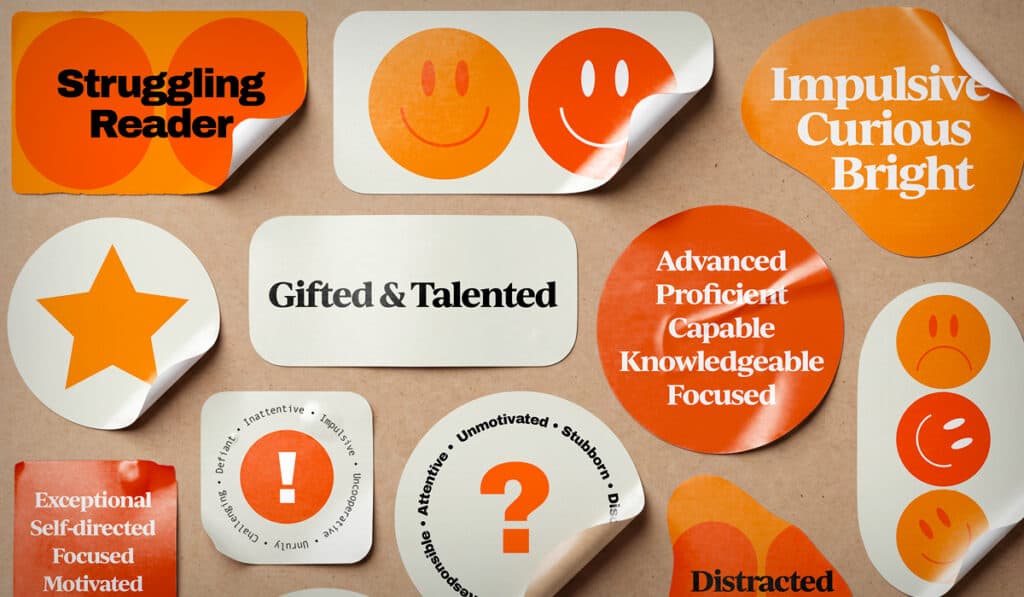
Labels applied to students by teachers—distracted, impulsive, curious, bright, struggling and many more—can from an early age shape how children see themselves and are hard to undo, according to an Education Week article.
“I think kids leave kindergarten not only with an idea and an expectation of school, but an expectation of themselves in school, like, ‘I’m gonna like this. I’m gonna be good at this—or not,’” says Susan Engel, a developmental psychologist who directs the teaching program at Williams College in Massachusetts.
Labels can stick long after they no longer fit. A student once described as a struggling reader can become a fluent reader, for example. But the negative identity caused by the original label can linger.
Negative identifiers, such as “slow” or “disruptive,” are obviously harmful. But “good” labels also come with potential pitfalls. Being identified as “gifted” creates pressure, wrote Danielle Sullivan, past president of the North Carolina Association for the Gifted & Talented, on the organization’s website. “(Students) fear disappointing the expectations tied to the label.”
That pressure may prevent a student from taking academic risks due to the fear of failing and, subsequently, tarnishing their reputation.
Praise and criticism — labeling students or their work as “good” or “bad” — are teachers’ two primary tools for giving feedback, Engel says.
Drop broad “evaluative” terms and point out specific aspects of students’ work, says Engel. “It’s more about helping students think about how they’re thinking, about their process,” she says.
Emily Bartz, a Baltimore-based learning specialist, trains K-12 teachers to assess student achievement in terms of executive function skills instead of considering it part of a student’s identity.
A student who appears unmotivated may struggle with task initiation, a key executive function skill that allows a shift from thinking about a task to actually beginning it, she says.
Bratz gives teachers a vocabulary to understand the relationship between students’ skill levels and behavior and offers strategies that support skill growth.
Heather Tibbetts, the lower school principal at Principia, an independent co-ed school in St. Louis, Mo., calls re-framing a “light-bulb moment.” Her K-5 teaching staff received training from Bartz prior to teacher-parent conferences. Explaining students’ progress in terms of their skills—rather than character or personality traits—produces more meaningful meetings with parents, she believes.
Rather than labeling kids, “it’s much more productive to share with parents which executive function skills their children are lacking, or which skill isn’t developed as much, especially knowing how we can teach that executive functioning skill to help students be more successful in school,” says Tibbetts.
Education Week